
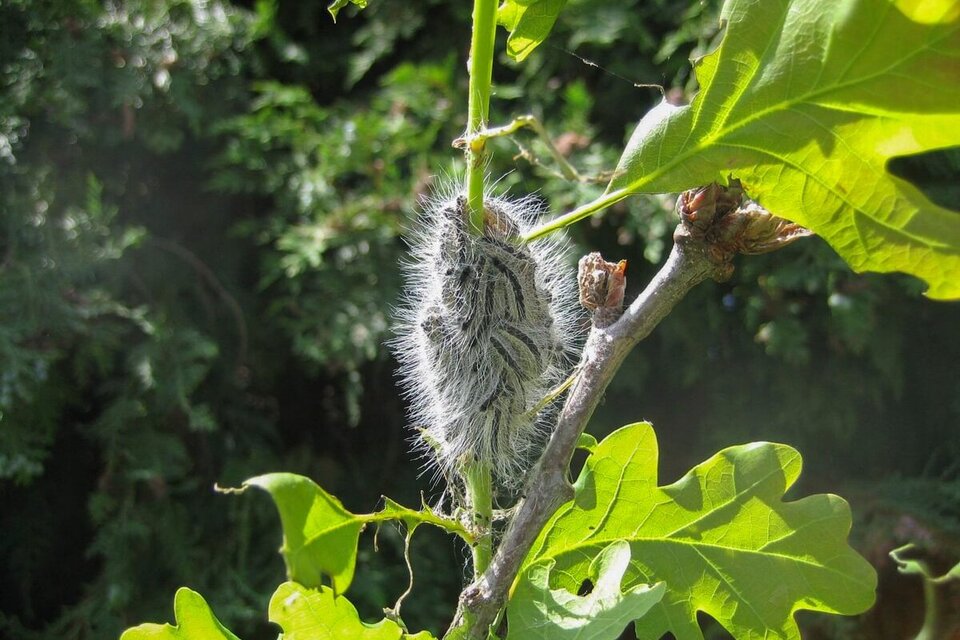
The public are being urged to be vigilant for any sightings of oak processionary moth caterpillars, a tree pest of oak trees.
The caterpillars – predominantly found in South East England – descend down oak trees in head-to-tail procession, earning them their name. They feed on the leaves as they move which can negatively impact the oaks growth. This can weaken the tree and leave it more vulnerable to other stresses, such as diseases.
The warning has been issued today by the Forestry Commission who are urging the public to report any sightings via the TreeAlert portal or by email to opm@forestrycommission.gov.uk, including a photo and location.
Oak processionary moth caterpillars are covered in long hairs that can cause itchy rashes, eye and throat irritation and should not be touched under any circumstances. They also form silky white nests, ranging in size from as small as a 50 pence piece up to a melon. These nests discolour over the season, appearing dirty and brown by August. The nests also contain the hairs, and similarly should not be touched. The nests can be found on the trunk or the underside of branches of oak trees. Members of the public are urged never to try and remove or dispose of the nests themselves.
Forestry Commission Oak Processionary Moth Programme Manager Dr Edward Straw said:
“The warm weather in spring has led to oak processionary moth growing quicker than in previous years and we may see higher infestation levels.
“It is important those living and working in areas affected by oak processionary moth remain vigilant in particular.
“The Forestry Commission has a whole host of information online that can be used to identify the moth, simply visit managing oak processionary moth in England. If you spot the pest, report the sighting via our TreeAlert portal. Alternatively, you can email opm@forestrycommission.gov.uk.”
Professor Nicola Spence, Defra Chief Plant Health Officer, said:
“Oak trees are an iconic and much-loved part of our British landscape. By reporting any sightings of oak processionary moth to the Forestry Commission, we can all minimise the pest’s spread as well as reduce their impact on tree health.
“I would advise that members of the public living in the South East, Derbyshire and Dorset, avoid any contact with the caterpillar and its nests, as this can cause irritation.”
Oak processionary moth was first identified in London in 2006 after being accidentally transported over from Europe in trees for planting. It has since spread to surrounding counties in the South East of England, and the Forestry Commission is presently managing two outbreaks outside of the South East in Derbyshire and Dorset.
The Forestry Commission continues to undertake a management programme and extensive surveillance work is in place to monitor the area and continue to direct appropriate control measures to prevent the potential spread of oak processionary moth.
Additional information:
How to identify Oak processionary moth caterpillars
- Nests are typically dome or teardrop-shaped, averaging the size of a tennis ball. They are white when fresh, but soon become discoloured and brown. The caterpillars have black heads and bodies covered in long white hairs which contain proteins which can cause itchy rashes, eye, and throat irritations. They can also occasionally cause breathing difficulties in people and pets, so should not be touched under any circumstances.
- A public information leaflet covering how to identify OPM and methods to control is available.
- There is also a document outlining species commonly confused with OPM which can be found.
- For more information, visit ‘Managing Oak Processionary Moth in England’.
Contact with Oak Processionary Moth
- Following possible OPM contact, visit your pharmacist for relief from milder skin or eye irritations. Consult a GP or call NHS111 for more serious reactions. Contact a vet if animals are seriously affected.
- An interactive map showing the locations of recent confirmed reports of OPM and the national management zones is available.
- A toolkit for local authorities and larger landowners to help plan for and manage OPM has been developed by the Tree Council, in partnership with Forest Research.
- A guide for traders of large oak trees on OPM moth management policy is available
- The Tree Health Pilot scheme offers a local authority grant for oak with OPM. It supports local authorities in the OPM ’established area’ to organise surveying of oak trees for OPM and create an OPM management plan and communications strategy to understand the risks and appropriate management of the affected area. Funding is also available for communications materials such as signage, and biosecurity items including boot cleaning equipment and red tape/posts for cordoning off areas.