
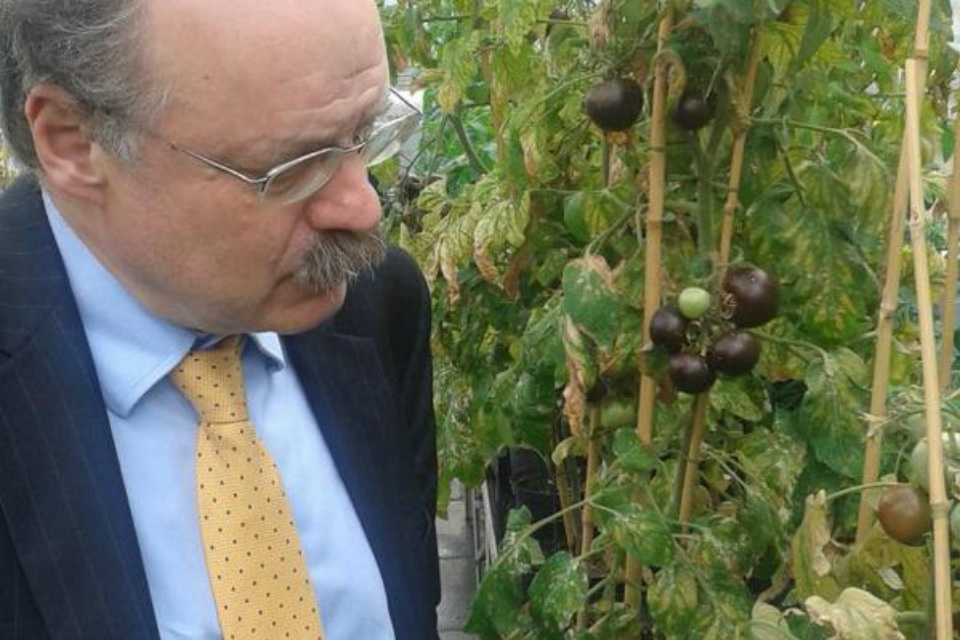
Sir Mark Walport visited plant and microbial science institute the John Innes Centre (JIC) and other partners on the Norwich Research Park on 2 May.
He saw cutting edge research to protect crops from global crop diseases and to grow more food more sustainably. He heard about recent advances that allow the production of pharmaceuticals by microbes and plants.
The natural diversity of plants is an important resource for innovation. For example, some wild grasses are resistant to a fungal disease called stripe rust that has caused up to 40% yield losses in large wheat-producing areas across the world. Protecting wheat with fungicides is expensive and environmentally damaging. With researchers from India and Africa, JIC scientists are instead harnessing natural diversity to develop new resistant wheat varieties adapted to local conditions.
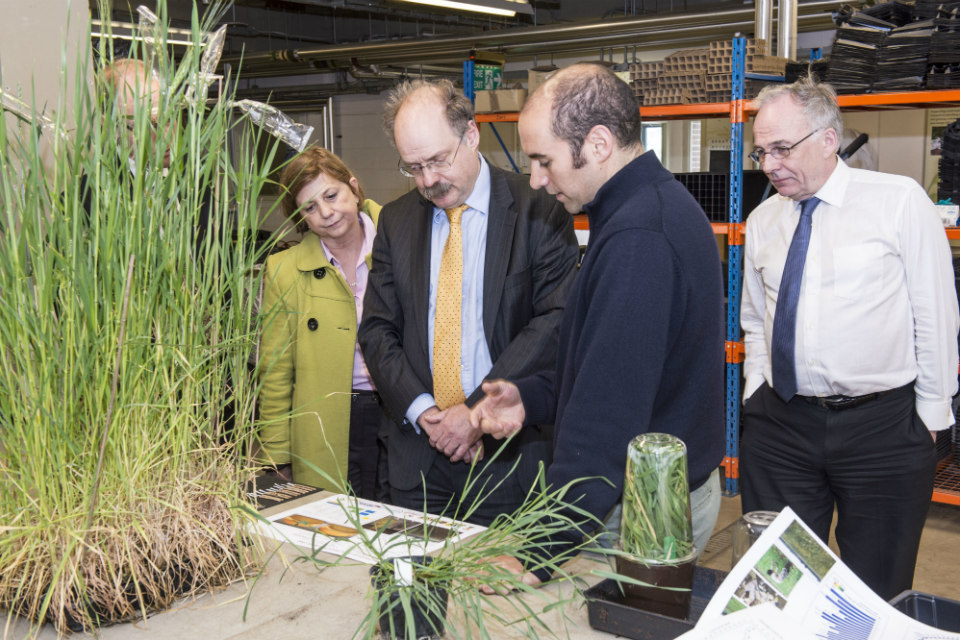
Dr Cristobal Uauy shows Sir Mark varieties of disease-resistant wheat.
Sir Mark learned about new plant breeding technologies including genome editing, where changes to plants can be as small as happens through natural variation and which do not involve introducing any foreign DNA.
He met scientists using GM technology to make crops richer in nutrition and more environmentally sustainable, including Professor Jonathan Jones from The Sainsbury Laboratory, one of the authors of the GM Science Update for the Council for Science and Technology.
Sir Mark Walport said:
The UK is a leading player in all forms of agricultural technology, including GM, and we need to encourage investment and research in this area.
When deciding whether genetic modification is the right technology to use we need to be specific about choosing the right gene, in the right plant for the right purpose.
Humans have a long history of genetically modifying crops. Modern bread wheats are a good example - they were genetically modified through breeding which was completely uncontrolled and unmonitored. Genetic modification by scientists is carefully controlled and allows selection of the gene, location and crop.
(Images courtesy of the John Innes Centre. More photographs of the visit are available from our Flickr channel).